

Wealth Management Update September 2026
Inflation Is Rising Again, But What Does It Actually Mean for Your Money?
Inflation has edged back into the headlines, rising from 2.6% to 2.9% in July, its highest level for four months.
For anyone who remembers inflation reaching double digits a few years ago, seeing it moving upwards again might feel a little uncomfortable. This time, one of the biggest contributors has been the increase in the household energy price cap, although inflation remains considerably below the levels we experienced during the height of the cost-of-living crisis.
But rather than worrying about whether inflation is 2.6%, 2.9% or whatever it happens to be next month, there’s a more useful way to think about it.
What matters is what your money can actually buy.
Imagine you had £100,000 sitting in cash and checked your account a year later to find you’d earned £3,000 in interest. On the face of it, you’re £3,000 better off. But if the things you spend your money on have also become roughly 3% more expensive, your actual spending power hasn’t really improved.
That’s the quiet effect of inflation. Your bank balance doesn’t fall, so it can be easy to overlook, but the value of what that money can buy gradually changes over time.
This doesn’t make cash a bad place to keep money. Far from it. Cash plays an important role in Financial Planning, particularly for emergencies, known expenditure and money you may need in the shorter term. The question is whether all of your money needs to be there, particularly if some of it won’t be needed for many years.
For longer-term money, Investments can provide the potential for growth above inflation, although of course that comes with Investment risk and values will fluctuate along the way. The aim isn’t to react every time the latest inflation figure is published, but to make sure your Financial Plan has the right balance between money you need to protect today and money that needs the opportunity to grow for tomorrow.
Inflation will rise and fall many times during a lifetime of Financial Planning. Rather than trying to predict every movement, the important thing is making sure your money continues to have a job to do and is in the right place to do it.
Source: ONS
Will Taxes Rise in the Autumn Budget?
With the Autumn Budget taking place on 28 October, it probably won’t surprise anyone that speculation about possible Tax rises has already begun.
Prime Minister Andy Burnham has refused to rule them out, pointing to the continuing pressure on the UK’s public finances and making it clear that any new spending commitments will need to be funded. Between now and Budget Day, we’re therefore likely to hear plenty about what the Government could change, from Tax rates and allowances to Pensions, Investments and Inheritance Tax.
Some of those predictions may prove accurate. Plenty probably won’t.
Rather than trying to second-guess the Chancellor, we think there’s a more useful question to ask: if the rules changed tomorrow, would your Financial Plan still be in good shape?
That’s an important distinction. Good Tax Planning isn’t about rushing to make a decision because somebody has predicted a change. It’s about making sensible use of the rules and allowances available today, whilst keeping enough flexibility to adapt when those rules inevitably change.
The run-up to a Budget can therefore be a useful prompt to review your own position. Have you made appropriate use of your ISA and Pension allowances? Are there Capital Gains Tax considerations you’ve been putting off? If Estate Planning is important to you, are your Wills, Trusts and gifting plans still doing what you intended? None of these decisions should be made simply because a Budget is approaching, but equally, valuable planning opportunities shouldn’t be overlooked while everyone waits to see what happens next.
One thing we can say with confidence is that Tax rules will continue to change throughout our lives. We’ve seen enough Budgets over the years to know that today’s allowances, thresholds and legislation won’t necessarily be tomorrow’s.
That’s why a good Financial Plan shouldn’t rely on the Tax system standing still. It should be reviewed and adapted as the world around it changes.
We’ll be keeping a close eye on the announcements on 28 October and, as always, we’ll explain what actually changes and what it means for your Financial Planning.
Until then, we’d rather plan around the rules we know than the rumours we don’t.
Until then, we’d rather plan around the rules we know than the rumours we don’t.
Post-Budget Briefing – 10am on 3rd November.
Following the Autumn Budget, we’ll be holding a Post-Budget Briefing at 10am on 3rd November, where we’ll cut through the headlines, explain the key announcements and look at what the changes could mean for your Financial Planning.
Save the date and register your space using this link – we’d love to see you there.
Inheritance Tax Isn’t Just a Tax for the Very Wealthy Anymore
For years, Inheritance Tax has been thought of as something that only affects the very wealthy. The latest figures from HMRC suggest that perception may need updating.
During 2023/24, 4.7% of UK deaths resulted in an Inheritance Tax liability, the highest proportion for almost 20 years. That still means fewer than one in 20 estates paid the Tax, but the amount collected reached a record £7.03 billion, while the average bill for those affected rose by £19,000 to £231,000.
What’s particularly interesting is why more families are finding themselves caught.
It isn’t necessarily because they’ve suddenly become considerably wealthier. Property and Investment values have risen over the years, whilst the main Inheritance Tax thresholds have remained frozen. Someone who bought an ordinary family home decades ago may therefore have accumulated an Estate worth far more than they ever imagined, particularly when savings, Investments, Pensions and other assets are added to the picture.
This is sometimes referred to as fiscal drag, but in everyday terms it simply means more people gradually finding themselves within the scope of a Tax that they never expected would apply to them.
And the landscape is changing again.
From April 2027, unused Pension funds and certain Pension death benefits are due to be brought within the scope of Inheritance Tax. For some families, that could significantly change the value of the Estate considered for IHT purposes and potentially bring people into the Tax net who aren’t currently affected.
That doesn’t mean everybody should suddenly start giving money away or changing their Pension arrangements. Inheritance Tax should never be looked at in isolation, and reducing a future Tax bill isn’t much of a victory if you’ve compromised your own Financial security or the life you wanted to enjoy along the way.
What it does mean is that Estate Planning deserves to become part of the conversation earlier.
Understanding what you own, who you want it eventually to pass to and whether your Wills, Pensions, Trusts, gifts and other arrangements still reflect those wishes can create far more options than waiting until later in life.
Ultimately, good Estate Planning isn’t simply about paying less Tax. It’s about making sure you can enjoy the wealth you’ve created during your lifetime, whilst having a clear plan for whatever is left.
Because the real question isn’t simply “Will my Estate pay Inheritance Tax?”
It’s “Will my money eventually go where I want it to go?”
Source: HMRC Inheritance Tax Liabilities Statistics
With changes to the way Pensions are treated for Inheritance Tax coming from April 2027, now is a particularly good time to make sure everything is up to date.
In our Who’s Getting Your Pension? briefing at 10am on Wednesday 2nd December, we’ll be looking at Expression of Wish forms, Death in Service benefits and Beneficiary nominations – who could receive what, why these forms matter and what can happen when life changes but the paperwork doesn’t.
It’s a timely opportunity to check that who you think will benefit from your Pension is actually who you’ve nominated.
Save the date and register your space nice and early using the link here.
Different Decade, Same Headlines
Someone recently sent us a photograph after coming across an old copy of the Financial Times.
The date was 6 August 1996, but it was the headline that caught our attention: “Tension between Iran and US unsettles markets.”
You could be forgiven for thinking she’d accidentally unearthed last week’s paper.
Almost 30 years ago, investors were reading about geopolitical tensions, nervous markets, currency movements and uncertainty about what might happen next. The names, numbers and circumstances may have changed since then, but the basic ingredients of Financial news appear remarkably familiar.
It’s a brilliant reminder of something that’s very easy to forget when you’re living through today’s uncertainty.
At almost any point in history, investors have been able to find a perfectly reasonable argument for being worried. We’ve lived through wars, recessions, political upheaval, elections, inflation, changing interest rates, financial crises and, more recently, a global pandemic. At the time, each event understandably felt significant because nobody knew exactly how things would play out.
Yet businesses continued to adapt, economies continued to evolve and Investment markets continued to move through good periods and difficult ones. None of that means world events should be ignored, nor does it mean Investments will always rise. It’s precisely why portfolios should be properly diversified and Financial Plans regularly reviewed.
What it does remind us is that uncertainty isn’t an interruption to investing. It’s part of investing.
That’s an important distinction, because if we waited until the world felt completely calm before investing, we might spend an awfully long time sitting on the sidelines. There will nearly always be an election approaching, a conflict somewhere in the world, an economic concern or a headline telling us why this time might be different.
Good Financial Planning isn’t about pretending those things don’t matter. It’s about building a plan that doesn’t require the world to behave perfectly in order to work.
Perhaps that’s the best lesson found underneath the carpet. The newspaper may have been nearly 30 years old, but the worries were surprisingly familiar.
And if somebody discovers a copy of the Financial Times from 2026 underneath their carpet in 2056, we’d wager they’ll probably think exactly the same thing.
Living Together Doesn’t Automatically Mean Legally Protected
More than 3.5 million couples in the UK live together without being married or in a civil partnership. They may have shared a home for decades, raised children together, combined their finances and, inevitably, disagreed about the correct temperature for the thermostat.
But there’s one thing they don’t automatically share: the same legal protections as a married couple.
Despite being one of those myths that refuses to disappear, there is no such thing as a “common-law marriage” in England and Wales. It doesn’t matter whether you’ve lived together for two years or twenty, simply sharing your lives doesn’t automatically give you the same rights as marriage or a civil partnership.
That can come as quite a shock, particularly when somebody dies.
If an unmarried partner dies without a valid Will, their surviving partner does not automatically inherit their Estate. There can also be complications around property ownership, Pensions, life assurance and other assets, particularly where nominations haven’t been reviewed or where it’s unclear who legally owns what.
The Government has been considering proposals to give eligible cohabiting couples greater protection if they separate or if one partner dies without a Will. That may eventually improve the position for millions of families, but the important point for anyone living together today is that the law hasn’t changed yet.
And even if it does, relying on legislation to decide what happens to everything you’ve spent a lifetime building probably isn’t much of a Financial Plan.
Good planning is about making your own wishes clear. That means having up-to-date Wills, checking Pension and life assurance nominations and understanding how your home is legally owned. Depending on your circumstances, a cohabitation agreement or declaration of trust may also be worth discussing with a solicitor.
None of this is particularly romantic, but neither is leaving the person you love trying to untangle your finances at an already difficult time.
Perhaps the simplest way to think about it is this: don’t assume the law knows what you would want.
If you’ve chosen to build a life together, it’s worth making sure the paperwork you’ve built around that life tells the same story.
Source: Gov.UK
Top 3 Cash ISAs
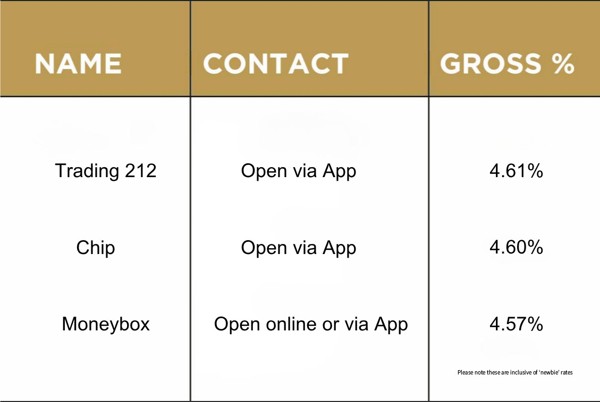
Please check the terms and conditions before opening any account. If in doubt, consult with your financial adviser directly, as the above is for your information only.
Source: Moneysavingexpert.com 07/09/2026